

If you’ve noticed that your lower teeth sit slightly in front of your upper teeth when you bite down, you may have already typed a version of this question into Google late at night: can clear aligners fix an underbite? It’s one of the most frequently asked questions by patients at their first consultation here at The Dental Studio, and frankly, it deserves a proper answer rather than a quick yes or no.
Well, honestly, it depends. Some underbites can be beautifully treated with clear aligners. Some need an entirely different approach. In this guide, we’ll walk you through what an underbite really is, why some cases are easier to treat than others, and how our dentists determine if you’re a good candidate before you sign on for any treatment plan.
What Exactly Is an Underbite?
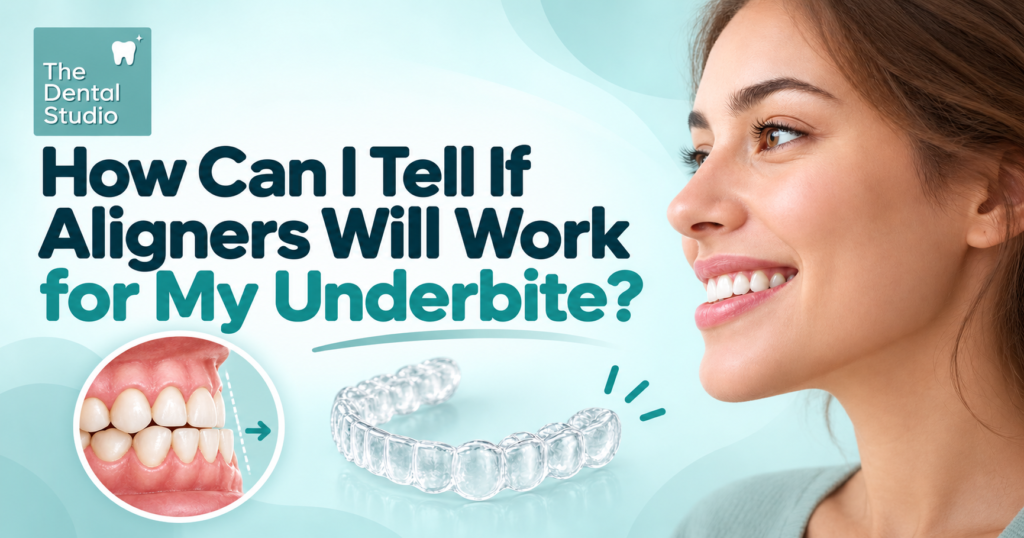
An underbite happens when your lower jaw or lower teeth stick out farther forward than your upper teeth when your mouth is closed. Dentists sometimes refer to this as a Class III bite. In a normal bite the upper front teeth are just ahead of the lower teeth. With an underbite, that relationship is reversed.
Not all underbites are created equal, and that’s really the crux of the whole issue. Some people have a slight underbite that is only noticeable if pointed out by a dentist. Some have a pronounced overbite, which changes the shape of the jawline and the way the teeth come together when chewing or talking.
An underbite, if left untreated, can result in uneven wear on the teeth, jaw pain, difficulty biting into foods and, occasionally, speech changes. That’s why it’s worth getting it checked out even if it doesn’t bother you cosmetically.
Tooth-Related vs Jaw-Related Underbites: Why This Distinction Matters
The type of underbite is the number one factor that will determine whether aligners will work for you, so it’s worth spending some time on it.
Dental (tooth-related) underbites
If you have a dental underbite, your jaw bones are actually aligned correctly. The problem is the angle or position of the teeth themselves in the jaw. Maybe the lower front teeth tilted forward. Maybe the upper teeth tilted back. In this case the underlying bone structure is fine, so these are the kind of underbite aligners that can actually correct it. Aligners move teeth, not bone.
Skeletal (jaw-related) underbites
A skeletal underbite is a structural problem. It could be that one of the jaws has elongated more than the other has elongated more than the other one. Alternatively, the upper jaw may not have elongated sufficiently. The movement of the tooth cannot alter the length of the jawbone. In these cases, clear aligners alone generally cannot entirely correct the bite, but they may cosmetically improve the alignment of the teeth.
The honest answer to “Can clear aligners fix an underbite?” always starts with figuring out what type you have. That’s precisely why. Your dentist can’t simply glance across the room at your smile and see the issue – it requires a proper clinical assessment.
When Clear Aligners May Actually Work
Aligners tend to be a strong option when:
- The underbite is mild to moderate, which means that there is a small overlap between the lower and upper teeth.
- The issue is primarily dental rather than skeletal; while jaw alignment is good, the individual teeth are not properly positioned.
- You have finished growing your jaw, which usually rules out most cases in growing children, where interceptive treatment is often more effective.
- Since underbite correction primarily depends on steady, controlled pressure, you are determined to wear your aligners for the recommended 20 to 22 hours per day.
- Your dentist may decide that if needed, attachments or elastics – tiny tools that help to apply extra force in certain directions – can be added to your aligners.
In these instances the aligners will gradually shift the lower and upper teeth into the position where they meet correctly. This can take anything from several months to well over a year, depending on the amount of correction required. Once we start mapping it out digitally, every case looks a little different.
Also, it’s worth remembering that the question of whether clear aligners fix an underbite isn’t just about severity alone. Two people with about the same amount of overlap can react very differently to treatment, depending on tooth shape, bite depth and the way their jaw joints move. That’s part of why generic answers from cookie-cutter articles usually don’t hold up when a dentist actually looks inside your mouth.
How a Dentist Checks If You’re a Suitable Candidate
Most people skip this step when researching online, but it’s where the real answer is. Here’s what usually happens when you come in for an evaluation at The Dental Studio:
1. A full clinical examination
Your dentist will check how your bite and jaw move and how much your upper teeth overlap your lower teeth.
2. Digital scans or X-rays
We take a 3D scan of your mouth and X-rays to get a clear picture of your jawbone structure, not just your teeth. And this is how we can tell if your underbite is dental, skeletal or a combination of both.
3. Bite and jaw relationship analysis
We can observe the position of your lower teeth in relation to your upper teeth and the proper functioning of your jaw joints.
4. An honest conversation about expected outcomes
If aligners are an option to fix your bite, we’ll walk you through what the treatment timeline looks like. If your case is more complex, we’ll explain why and what your options are—no pressure to choose one.
This is really the only way to answer the question for your particular mouth. Generic articles and quizzes online can give you a rough idea, but they can’t substitute for a scan and trained eye examining your actual bite.
Other Treatment Options for More Severe Cases
If your underbite is skeletal or just too severe to be taken care of with aligners alone, that doesn’t mean you’re out of luck. All it means is that a different approach is often better:
- Traditional braces: Sometimes, when there’s a need for more complex tooth movements, braces can fix things that aligners alone can’t, especially whether there’s a lot of rotation or vertical movement needed.
- Elastics on braces or aligners. Rubber bands attached between the upper and lower arches can help guide the jaws and teeth into a better relationship over time.
- Orthognathic (jaw) surgery: If you have a severe skeletal underbite, surgery can be done in conjunction with orthodontic treatment to reposition the jaw itself. It is usually reserved for adults with severe jaw discrepancies.
- Early interceptive treatment: While children are still growing, we can use various appliances, such as palatal expanders or certain devices, to help guide jaw growth to help stop potential bite problems from getting worse later on.
None of this should be alarming. Correcting an underbite is one of the better understood areas of dentistry, and the right treatment plan is simply a matter of what’s actually causing your bite to sit the way it does.
Frequently Asked Questions
Can clear aligners fix an underbite completely?
Yes, for mild to moderate dental underbites, aligners can often completely correct the bite. In skeletal underbites, aligners can improve the look and positioning of the teeth, but they usually can’t correct the underlying jaw discrepancy on their own.
How long does it take to fix an underbite with aligners?
The duration varies quite a lot. Mild cases can have meaningful corrections in 6-12 months, while more involved cases may take longer. Once your scans are reviewed, your dentist will be able to give you a realistic time frame.
Will I need attachments or elastics with my aligners?
Attachments and elastics are not required in all cases, but they can be beneficial for many individuals with underbites. Attachments are small tooth-coloured bumps bonded to select teeth, and elastics connect the upper and lower aligners to help guide the bite into place.
Can adults get their underbite corrected, or is it too late?
It’s always too late. Adult jaws are fully developed, so treatment may take a bit longer than it would for a teen, but many adults successfully correct dental underbites using aligners.
What happens if aligners alone can’t fix my underbite?
Your dentist will discuss with you other options, such as braces, elastics or jaw surgery in more severe cases. You won’t walk away without knowing what to do next.
Conclusion
So, can clear aligners fix an underbite? Yes, for many people, especially as far as the position of the teeth, not the structure of the jaw. But you can only be sure with a proper evaluation looking at your bite, jaw and teeth together, not just a quick peek in the mirror.
If you’re wondering whether clear aligners could fix your underbite, the team at The Dental Studio can run you through a full assessment and give you a straight answer, with a treatment plan that actually suits your bite. Set up a consultation with us, and let’s find out what will really work for your smile.